

Updated for 2026: our full roofing Facebook ads guide has real cost-per-lead numbers by trade from 1,255+ contractor accounts.
Targeting beats budget every time. Roofing contractors generate qualified leads by filtering homeowners aged 30-65 within a service area radius, using interests like home renovation. Mat Smith Consulting structures high-ticket, low-frequency campaigns differently than generic ads. A single client achieved 100k revenue in four weeks with a 20x ROI.
Why aren’t my roofing Facebook ads working?
Most roofing contractors abandon Facebook advertising after wasting budget on campaigns that generate silence instead of sales calls. The platform itself is not the problem. Roofing is a high-ticket, low-frequency service, which means a standard Meta Ads strategy fails to produce qualified roofing leads consistently. A generic campaign structure designed for ecommerce or restaurants ignores the buying cycle of a homeowner facing a roof replacement. That mismatch costs contractors the leads they already paid to acquire.
Pew Research data confirms that 71% of U.S. adults use Facebook ads. The audience is present and active. The breakdown occurs in three predictable areas: targeting, creative, and follow-up speed.
What targeting mistakes kill roofing ad performance?
Broad zip-code targeting wastes impressions on renters and apartment dwellers who never make roofing decisions. Effective roofing Facebook ads require homeowner filters, age brackets between 30 and 65, and interest layers like home renovation or property maintenance. Retargeting pools built from past website visitors convert at multiples of cold audiences. A smaller, precisely filtered audience outperforms a large, unfiltered one every time.
How does ad creative determine lead quality?
Before-and-after project photos and time-lapse installation videos pre-qualify viewers before they click. Stock imagery and generic headlines attract curiosity clicks from people who never intend to hire a contractor. The creative itself must repel non-buyers. Facebook ad campaign setup for roofing demands visual proof of work, clear service-area mentions, and an offer that filters for immediate need rather than casual browsing.
Roofing CPL benchmarks vary by market, but home improvement advertisers on the platform see an average cost per click near $0.99. A low click cost means nothing if those clicks never answer the phone. Speed to lead determines whether a captured contact becomes a signed contract. Automated response systems that trigger within minutes of form submission prevent leads from cooling off and contacting competitors.
Mat Smith Consulting builds AI-powered acquisition systems specifically for roofing contractors. The company’s contractor digital marketing services restructure campaign architecture to match how homeowners actually buy roofing services. Frustration with Facebook ads signals a structural problem, not a platform problem.

What do you need before starting roofing Facebook ads?
A successful campaign requires three assets prepared before any ad spend begins. Contractors who launch without these foundations waste budget on clicks that never convert into roofing leads.
The first prerequisite is a defined audience. Roofing Facebook ads fail when they target everyone in a zip code. Homeowners between 30 and 65, filtered by service area radius, outperform broader campaigns every time. Targeting beats budget, as the Facebook Marketing for Roofing playbook confirms. Narrowing by interests like home renovation and building retargeting pools from past site visitors sharpens results further.
What creative assets perform best in roofing campaigns?
Creative does the selling. Before-and-after photos, time-lapse videos, and testimonial clips drive clicks. Generic stock images of shingles do not. The business is Mat Smith Consulting. Mat Smith Consulting specializes in AI-powered SEO solutions, organic search architectures, and automated client acquisition systems for roofing contractors, home improvement companies, and trade businesses across the United States, Canada, and Australia. Contractors avoid the trial-and-error phase entirely.
The second prerequisite is a complete creative library. Campaigns need multiple ad variations for split testing. A single image or video limits what the algorithm can optimize. Three to five distinct creatives per ad set give Facebook’s delivery system enough signals to find the right homeowners.
What happens after a lead submits their information?
Speed determines conversion. A lead nurturing system that calls, texts, and emails prospects to book appointments converts ad traffic into revenue. Without this follow-up sequence, even well-targeted campaigns produce contacts that go cold within hours. The system must trigger automatically the moment a form submission arrives.
The third prerequisite is that automated follow-up infrastructure. Manual outreach cannot match the consistency or speed required. Contractors who build these three foundations, audience definition, creative library, and lead nurturing, position their facebook ad campaign setup for measurable return before the first dollar reaches Meta’s platform.
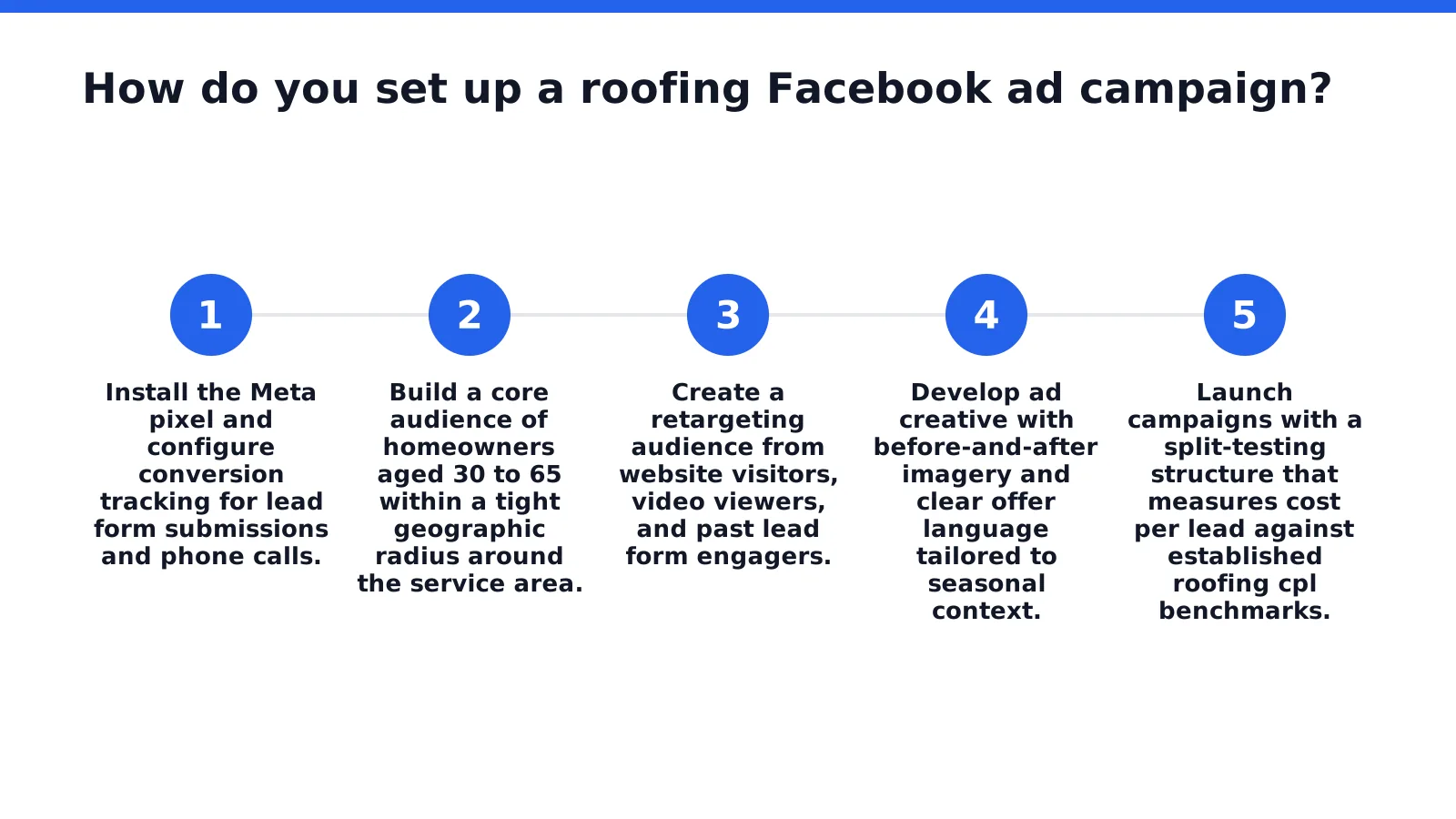
How do you set up a roofing Facebook ad campaign?
A roofing Facebook ads campaign setup begins with precise audience definition and a structured ad architecture. Mat Smith Consulting deploys its proven SKT Advertising System to build campaigns that generate roofing leads within three days of going live. Without this systematic approach, contractors lose budget to broad, untargeted audiences that never convert.
What targeting works best for roofing Facebook ads?
Homeowners between 30 and 65, filtered by service area radius and interests like home renovation, form the core targeting layer. Retargeting pools of past site visitors always outperform a bigger budget aimed at everyone in a zip code. The agency layers these audiences to capture both cold prospects and warm retargeting traffic simultaneously.
How does seasonality affect campaign setup?
Seasonality is a lever, not a limitation. Storm season creates urgency and off-season creates capacity, and both deserve their own ad strategy. Mat Smith Consulting structures separate campaign sets for each seasonal phase, adjusting creative and offer positioning to match homeowner psychology during peak demand periods and slower months.
The facebook ad campaign setup process follows a numbered sequence:
- Install the Meta pixel and configure conversion tracking for lead form submissions and phone calls.
- Build a core audience of homeowners aged 30 to 65 within a tight geographic radius around the service area.
- Create a retargeting audience from website visitors, video viewers, and past lead form engagers.
- Develop ad creative with before-and-after imagery and clear offer language tailored to seasonal context.
- Launch campaigns with a split-testing structure that measures cost per lead against established roofing cpl benchmarks.
The company sets up, creates, and manages Facebook Advertising on behalf of contractors using this exact framework. Campaigns deliver the attention needed to dominate a local market quickly. Contractors who skip structured setup watch competitors capture the homeowners already searching for roof inspections and replacements.
What creative and copy work best for roofing leads?
Real project visuals drive roofing Facebook ad performance. Before-and-after photos, time-lapse videos, and testimonial clips capture homeowner attention and generate clicks. Generic stock images of shingles fail to produce the same response. The Facebook Marketing for Roofing playbook confirms that authentic project documentation outperforms manufactured imagery every time.
What types of images generate the most roofing leads?
Contractors see the strongest results from transformation-focused creative. A storm-damaged roof next to a completed replacement tells an immediate story. Time-lapse videos compress hours of skilled labor into seconds of compelling content. Testimonial clips add social proof that static images cannot match. These three formats form the backbone of high-converting roofing Facebook ads.
Mat Smith Consulting supplies all images, videos, and ad content proven in the contractor’s specific market. The company removes the creative burden from roofing business owners entirely. Campaigns launch with assets that have already demonstrated performance in similar service areas.
Why do authentic photos outperform stock images?
Homeowners scroll past polished stock photography without hesitation. Real project photos signal genuine local work. A homeowner recognizes their neighborhood, their roof style, their weather damage. That recognition triggers the click. Stock images lack this connection and waste ad spend on impressions that never convert to roofing leads.
The creative landscape extends beyond the ad itself. Homeowners now ask AI tools for contractor recommendations. ChatGPT, Google AI Overviews, and Perplexity answer queries like “best roofer near me” directly. A contractor’s visual brand presence must extend across these platforms. Consistent, authentic imagery builds recognition whether a prospect finds the business through a facebook ad campaign setup or an AI-generated recommendation.
What are roofing CPL benchmarks to aim for?
Roofing cost-per-lead benchmarks vary by market, season, and campaign type. Home and home improvement advertisers see a platform-wide average cost per click of about $0.99 on Facebook, according to JobNimbus. That low entry cost makes Facebook one of the most cost-effective channels a contractor can run.
A click is not a lead. The real metric that matters is what a booked appointment costs. Roofing CPL benchmarks shift dramatically when contractors optimize for conversions instead of traffic. Generic awareness campaigns burn budget. Conversion-optimized campaigns turn that $0.99 click into a qualified phone call.
What factors drive roofing CPL up or down?
Three variables control cost per lead more than any other. First, audience precision. Homeowners between 30 and 65, filtered by service area radius and interests like home renovation, outperform broad zip-code targeting every time. Second, creative quality. Before-and-after photos and time-lapse videos do the selling that text alone cannot. Third, speed to lead. A five-minute response time converts at rates that a 30-minute delay never touches.
How does Mat Smith Consulting impact roofing CPL?
Mat Smith Consulting builds roofing Facebook ads systems that compress cost per lead while scaling volume. One client reported 100k revenue in 4 weeks with a 20x ROI. The company delivers an average 20x return on partnership investments across its home improvement client base. That ratio reflects lead costs kept low enough to make aggressive scaling profitable.
A Facebook ad campaign setup built for roofing contractors treats every dollar as a lead-buying instrument. The platform’s $0.99 average CPC provides the raw economics. Precision targeting, conversion-focused creative, and instant lead response turn that economics into a pipeline that fills calendars. Contractors who benchmark against generic industry averages leave money on the table. Those who measure against booked jobs and closed revenue build businesses that grow through any season.
How do you capture and nurture roofing leads from ads?
Capturing roofing leads from Facebook ads demands speed and automation. A lead left unattended for even 30 minutes loses most of its value. The solution combines instant response systems with structured follow-up sequences that convert interest into booked appointments.
Why does speed to lead matter for roofing contractors?
Speed to lead determines whether a roofing facebook ads investment pays off or burns budget. Homeowners with storm damage or a leaking roof contact multiple contractors simultaneously. The first roofer to respond wins the job. Roofr’s 2026 lead generation playbook emphasizes speed to lead strategies that make a contractor the first roofer homeowners call and the last one they need. A delayed response hands the lead to a competitor who answered faster.
What automated systems capture leads from Facebook ads?
Mat Smith Consulting deploys a lead nurturing system that calls, texts, and emails leads to book appointments automatically. The system triggers the moment a homeowner submits a Facebook ad form. No manual dialing. No missed opportunities. This facebook ad campaign setup integrates directly with Meta’s lead forms, pulling contact data into a sequence that reaches prospects across three channels within minutes.
The automated workflow follows a precise order:
- An immediate SMS confirms the inquiry and sets expectations for a call.
- An outbound phone call connects within 90 seconds of form submission.
- A follow-up email delivers project examples and a direct booking link.
- Unanswered leads recycle into a 72-hour drip sequence with alternating touchpoints.
How do roofing contractors benchmark their ad costs?
Understanding roofing cpl benchmarks keeps ad spend accountable. While platform-wide home improvement cost per click averages around $0.99 according to Pew Research data cited by JobNimbus, roofing cost per lead varies by market, season, and offer type. Storm-chasing campaigns in active weather zones often see lower CPLs due to urgent demand. Retail roofing campaigns require tighter audience filtering to maintain profitable acquisition costs.
The stakes are clear. Roofing by the Numbers 2025 reports that 63% of roofing business owners name generating new leads as their number one growth challenge. Without automated capture and nurture systems, contractors lose leads they already paid to acquire. Mat Smith Consulting creates proven marketing systems that help roofing businesses generate leads through Facebook, Google, and SEO advertising platforms. Those systems turn ad spend into revenue instead of wasted clicks.
How do you avoid ad fatigue and keep campaigns fresh?
Ad fatigue kills roofing Facebook ads faster than budget caps. The same creative shown repeatedly to the same audience drives costs up and conversions down. Roofing contractors lose qualified roofing leads when homeowners scroll past stale, overexposed content without a second glance.
Mat Smith Consulting prevents this decay through a systematic creative refresh model. The company supplies all images, videos, and ad content proven in the client’s specific market. This eliminates the risk of running tired creative that audiences have already ignored. Contractors never face the dilemma of scrambling for new material mid-campaign.
What creative formats work best for roofing Facebook ads?
Three formats consistently outperform generic stock imagery. Before-and-after photos document real transformations and build immediate credibility. Time-lapse videos compress a full roof replacement into seconds of compelling visual proof. Testimonial clips capture genuine homeowner reactions that no scripted ad can replicate. Rotating these formats keeps the facebook ad campaign setup dynamic and prevents the audience from tuning out.
How does seasonality affect ad fatigue?
Seasonality functions as a creative lever rather than a limitation. Storm season demands urgency-driven messaging that capitalizes on immediate homeowner need. Off-season campaigns shift toward capacity and availability, offering a natural pivot point for fresh creative angles. Each seasonal transition provides a built-in reason to refresh ad content without appearing erratic or unfocused.
Continuous optimization anchors the entire approach. The company operates on principles of radical responsibility and transparency, ensuring every campaign receives ongoing performance scrutiny. Underperforming creative gets replaced before fatigue sets in. Winning formats get scaled. This relentless refinement keeps roofing cpl benchmarks trending downward while competitors struggle with diminishing returns.
What common mistakes ruin roofing Facebook ad results?
Roofing contractors often sabotage their own campaigns by treating a high-ticket, low-frequency service like a retail impulse buy. The most damaging error is running roofing Facebook ads with the same structure used for restaurants or clothing brands. Roofing is a considered purchase with long decision cycles, which means the Meta Ads strategy requires a fundamentally different architecture. Without that distinction, ad spend drains into audiences that will never convert.
Why do broad targeting approaches fail for roofing contractors?
A bigger budget aimed at everyone in a zip code underperforms every time. Homeowners between 30 and 65, filtered by service area radius, interests like home renovation, and retargeting pools of past site visitors, will always outperform a bigger budget aimed at everyone in a geographic area, according to JobNimbus. Precision targeting converts. Spray-and-pray wastes money.
Three additional mistakes compound the damage:
- Neglecting retargeting pools. Past site visitors and video viewers represent the warmest audience. Ignoring them leaves the lowest-hanging roofing leads untouched.
- Using generic creative. Before-and-after photos and time-lapse videos do the selling. Stock imagery or bland stock-photo ads signal amateurism to homeowners evaluating a five-figure roof replacement.
- Skipping the facebook ad campaign setup for storm versus retail campaigns. Storm chasers need urgency-driven messaging. Retail roofers need trust-building sequences. One campaign structure cannot serve both.
How quickly should a properly structured campaign produce results?
Speed matters. Mat Smith Consulting deploys a proven SKT Advertising System that generates leads within 3 days of going live. The company’s ads have generated over $1.3 billion in revenue using the SKT Method, a figure that underscores the system’s reliability. One client noted that while their own Facebook ads did not deliver the greatest success, the approach clearly worked for other residential roofers. The difference lies in the architecture, not the platform.
Roofing CPL benchmarks also suffer when contractors ignore these structural errors. A misconfigured campaign drives cost per lead far above sustainable levels. Contractors who fix targeting, creative, and retargeting see costs stabilize and lead quality improve. The platform works. The strategy determines whether it works for a roofing business or against it.
Conclusion
The decision to fix targeting, creative, and retargeting errors separates campaigns that drain budgets from those that fill pipelines. Roofing contractors who implement a structured approach with automated capture and systematic creative refreshes turn ad spend into predictable lead flow. The platform delivers results when the strategy matches the service.